

Beyond the Camino, among pazos, camellias, rías, and landscapes shaped by the wind
An ancient Galician pazo slowly reclaimed by nature. Vegetation winds its way through the rooms, intertwining with furniture and objects that once belonged to those who lived there, while camellias emerge like traces of a memory still alive. This is the image chosen to portray Galicia at Orticolario , the international event dedicated to landscape and the culture of nature, scheduled for October 1–4 at Villa Erba on Lake Como.
Spain is participating for the first time with an immersive space dedicated to this Atlantic region. More than just a set design, the installation feels like a statement of identity: in Galicia , nature, architecture, and the domestic sphere do not occupy separate realms, but coexist, overlap, and transform one another.
It is also an opportunity to look beyond the region’s best-known image. For centuries, its geography has been interpreted as a point of convergence: all roads led to Santiago de Compostela . The symbolic power of the Way has thus come to overshadow a much more diverse heritage, consisting of historic homes, gardens, granite cities, vineyards, rugged coastlines, and rías shaped by the tides.

THE PAZOS AND THE CAMELLIA TRAIL
Having arrived in Europe from the East, the camellia found an ideal habitat in the mild, humid climate of Galicia. Introduced between the 18th and 19th centuries into the gardens of the pazos—the region’s ancient noble residences—it has, over time, become a distinctive feature of the Galician landscape.
The Camellia Route now connects historic parks, estates, and gardens in the provinces of A Coruña and Pontevedra. The route includes sites such as the Pazo de Mariñán, Santa Cruz de Ribadulla, Oca, Rubianes, and Quinteiro da Cruz, as well as Soutomaior Castle and the Pazo Quiñones de León. Botanical collections, monumental specimens, and aristocratic architecture come together to form a route that reaches its most spectacular moment between winter and spring.
It’s not just a floral journey. The pazos embody a unique concept of living, in which the manor house, the garden, the farmland, and the surrounding landscape come together as a single design. Nature does not merely adorn the architecture; it complements it and, over time, almost absorbs it.
SANTIAGO, LOOKING UP
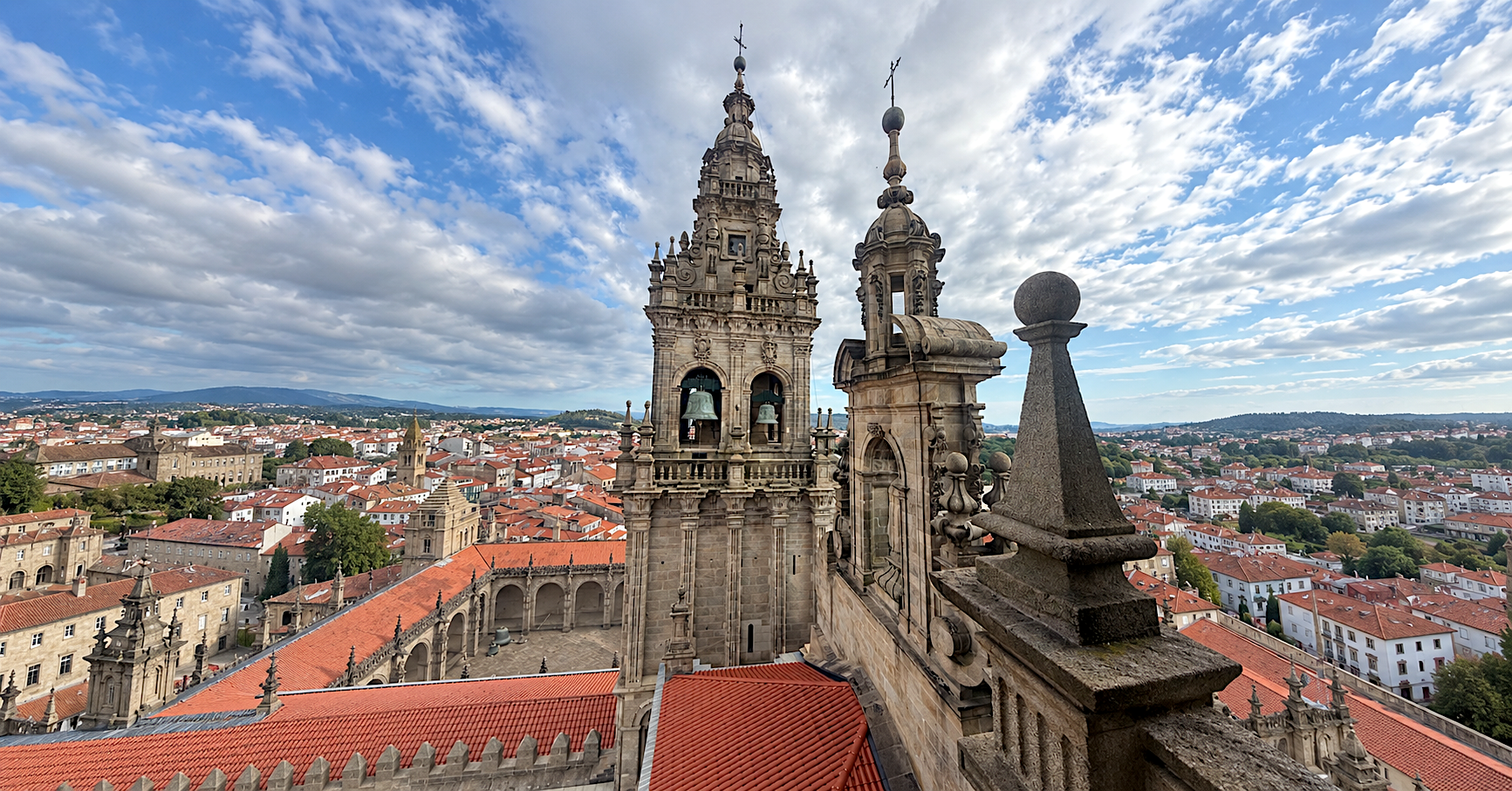
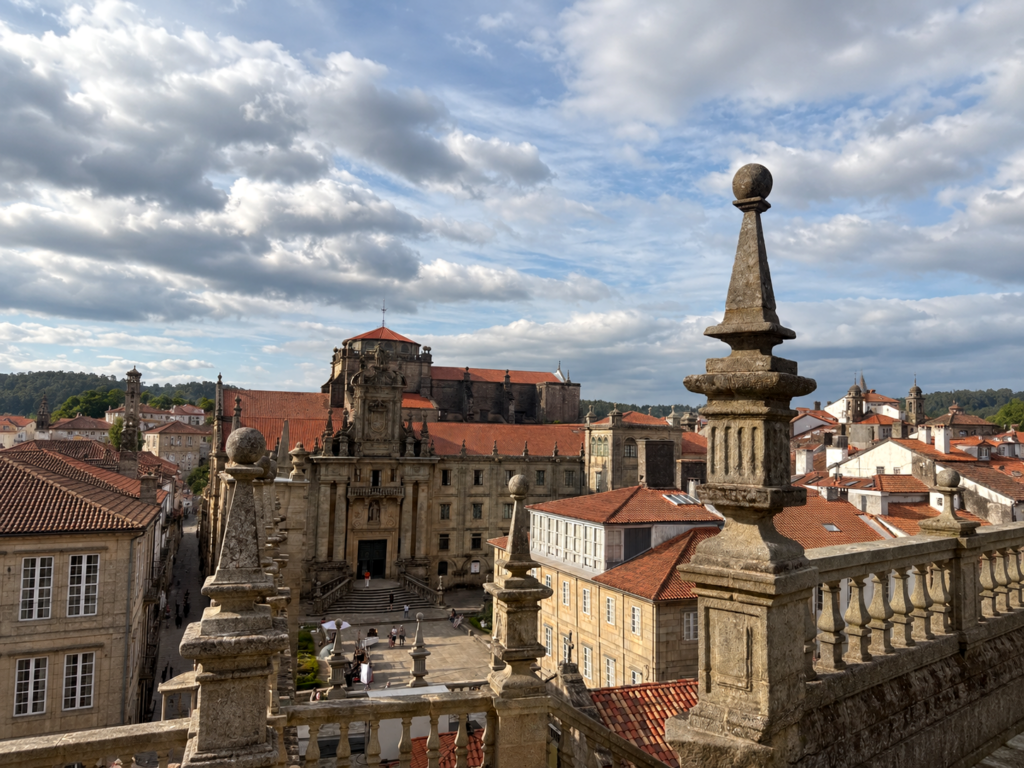
In Santiago de Compostela, your gaze is inevitably drawn upward. Towers, bell towers, balustrades, and Baroque facades create a vertical city, while the granite shifts in hue as the light and rain change. Here, even the sky is part of the architecture.
Climbing onto the cathedral’s rooftops allows you to observe up close the building’s complexity and its relationship with the city. Roofs, towers, and passageways interact with convents, cloisters, and squares, revealing a layered history in which Romanesque, Gothic, and Baroque styles continue to coexist.
The Hotel Monumento San Francisco , housed in a former convent just a short walk from the Cathedral, preserves the intimate character of the original building without turning history into mere scenery. Not far away, the Mercado de Abastos, on the other hand, captures the everyday life of Santiago. Fish, shellfish, vegetables, and cheeses form the basis of a contemporary cuisine that reinterprets tradition without straying from it, as is the case at Abastos 2.0 and Anaco.
THE CHANGING GEOGRAPHY OF THE RÍAS
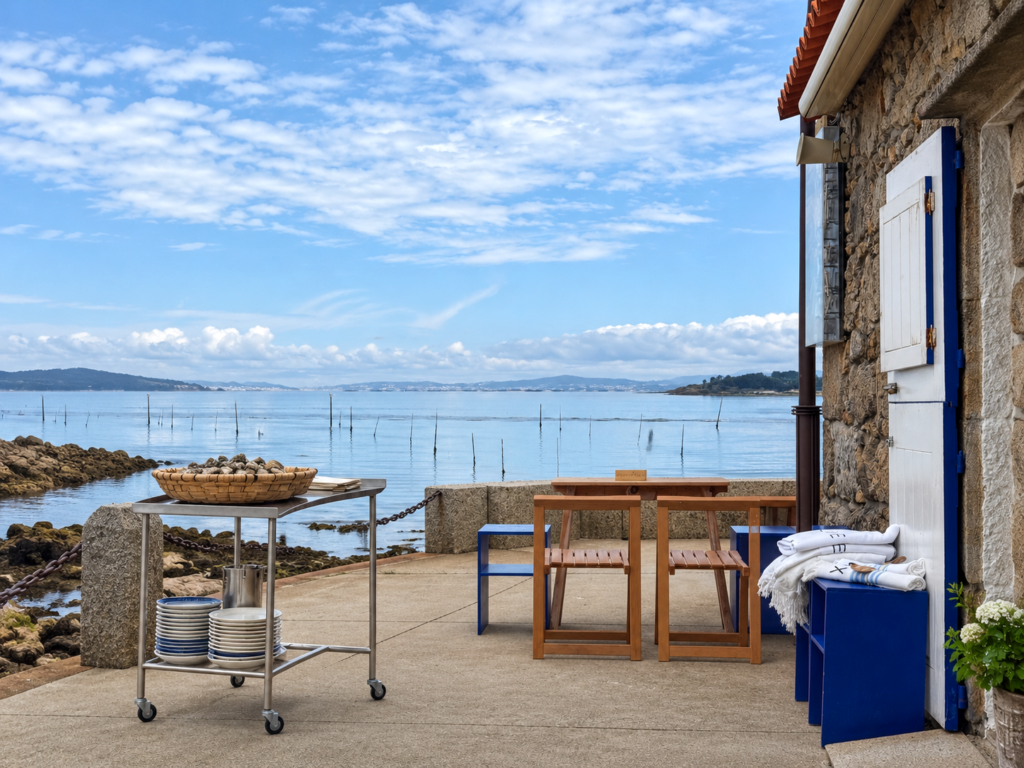
To truly understand Galicia, however, you must go to the Atlantic. In Carril, in the province of Pontevedra, the landscape never takes on a definitive form. The tides ebb and flow, submerging the sandbars and then revealing them again, setting the rhythm for those who gather clams and shellfish.
The rías are transitional areas where fresh and saltwater meet, and the natural landscape blends with the productive one. Watching the manual harvest means entering a system governed not by the clock, but by the movement of the water and by knowledge passed down through generations.
At the restaurant O Loxe Mareiro , overlooking the Ría de Arousa, this heritage is transformed into cuisine. Local seafood is prepared with restraint, preserving its texture, freshness, and natural saltiness. True luxury lies in the proximity between the source and the plate, in the ability to recognize the landscape within what you taste.

CASA NORDÉS: THE REGION IN A GLASS
About twenty kilometers from Santiago, Casa Nordés brings together many of the experiences encountered during the journey. Nestled in lush greenery, it is a place where botany, distillation, gastronomy, and crafts come together to form a cohesive narrative.
The tour takes visitors through the Founder’s House, the greenhouse, and the distillation room. Bay laurel, sage, lemon verbena, eucalyptus, peppermint, and glasswort form an olfactory atlas of Galicia. These botanicals are joined by juniper, cardamom, ginger, hibiscus, and black tea—a testament to the trade of a land facing the ocean.
Nordés is made from a wine distillate derived from Albariño grapes, to which botanicals—macerated separately and then combined during the final distillation—are added. Even the white-and-blue bottle evokes the ceramics of Sargadelos, while the compass rose refers to the northeasterly wind that heralds good weather.
After Santiago, Carril, and the coast, those aromas already feel familiar. In the glass, the flavors of grapes, herbs, the sea breeze, and the freshness of the Atlantic landscape return. Perhaps this is the key to discovering Galicia beyond the Camino: following the connections between nature, architecture, cuisine, and material culture. Not a succession of destinations, but a region to be observed slowly, letting the wind be your guide.

